
Top Signs You Need Garage Door Service – Don’t Ignore These
The earliest sign a garage door needs service is rarely a loud bang. It’s a door that takes one or two seconds longer to open than it did six months ago, a faint grind at the start of travel, or a slight lean you notice from the driveway. Those small changes usually show up 60 to 90 days before a part actually fails, and that window is where a minor adjustment or a cheap part stops a much bigger repair. Almost every “warning signs” list out there describes the end-stage failures any homeowner already sees: a snapped spring, a door stuck halfway, a car trapped inside. The useful signals come earlier, and they’re mechanical. This guide walks through the ones we look for first.
We’re not going to tell you everything is urgent. Plenty of small noises are harmless. But the five signals below are the ones that consistently precede real failures, and they’re worth understanding whether you fix them yourself or bring in a technician. If you’d rather not poke around a moving door with a flashlight, call (844) 569-7232 and we’ll take a look.
Key Takeaways
- A door that opens slower than it used to usually means a torsion spring has lost tension and is now straining the opener motor.
- The 60-second balance test is the single best early indicator of spring wear.
- Cable fraying has a visual tell: loose, unwinding strands mean days, not months.
- Uneven travel speed points to a cable tension problem on one side.
- Grinding, squeaking and rattling each trace to different hardware, and each means something different.
- Colorado altitude and temperature swings make October and April the two checkpoints worth keeping.
The 60-Second Balance Test That Catches Spring Wear Early
The balance test is the most useful check a homeowner can do, and it takes about a minute. It works because a healthy torsion spring holds the door’s weight in equilibrium, so the door should stay put wherever you leave it. A worn spring loses that tension quietly, long before it snaps. Here’s how it goes, and it’s a test, not a repair. Don’t try to adjust springs yourself; that’s the part we’ll cover below.
- Close the door and pull the emergency release cord so the door is disconnected from the opener. You’re now handling the door by hand.
- Lift the door to about waist height and let go gently. A balanced door stays where you left it.
- Lift it to shoulder height and repeat. It should hold again.
- Lift it to about chest height and repeat.
What “passing” looks like: the door stays put within a few inches at each of those three heights. What failing looks like: the door sinks toward the floor under its own weight, or it feels heavy enough that lifting it takes real effort. A door that sinks at any of those positions is telling you the springs are under-tensioned and the opener is quietly doing the lifting the springs should be doing. If the door drops fast, step away and call a technician. In Southlands, cold snaps push door weight around, so run this test after the first hard freeze of the season as well as in spring.
Why a Slower-Opening Door Points Straight at Your Springs
Garage doors don’t “get old” in the way a piece of furniture does. They hold tension or they don’t. When a door starts opening a beat slower than it used to, or the opener sounds like it’s working harder, the usual cause is a torsion spring that has lost measurable tension. The spring is no longer helping lift the door, so the opener motor takes on the full load. The motor is designed to move a balanced door, not dead-lift a heavy one, so it runs hotter and wears faster. We’ve seen far more opener failures that started as an under-tensioned spring than we’ve seen openers fail for any other reason.
You can hear it before you see it. A LiftMaster or Chamberlain opener that used to be quiet often starts to sound strained at the start of travel, then the door itself feels heavier in the balance test. Raynor and Genie units behave the same way. That strain is the sound of a motor doing more work than it should. Once an opener has been overworked for a while, it develops its own problems, which is why a slow door is worth a look now rather than after the opener joins in. If your opener is already showing symptoms, garage door opener repair is usually the place to start, but the door balance matters just as much.
Cable Fraying: Normal Wear vs. Active Unraveling
Cables fray in two very different ways, and telling them apart is a matter of days versus months. Normal wear looks like a few dull, tightly wound strands with minor surface scuffing, and it develops gradually over a long service life. Active unraveling looks like loose, curved strands breaking away from the bundle, or a cable that’s visibly started to twist open like a rope end. If you see the second kind, stop using the door. The visual distance between “a little worn” and “about to let go” is short, and a snapping cable can whip. Don’t run the door to “test” it. Let a technician look.
To check safely: with the door closed and the opener disconnected, look at the cables along the sides. They should sit neatly in their tracks with no slack and no loose strands. Slack on one side is another warning sign we’ll get to next. In Southlands, the dry winters and temperature swings can accelerate cable wear, so if you’re doing the balance test, glance at the cables the same morning. We work on the major brands – LiftMaster, Raynor and others – so we can read whatever’s on your door.
Uneven Travel Speed: One Side vs. the Other
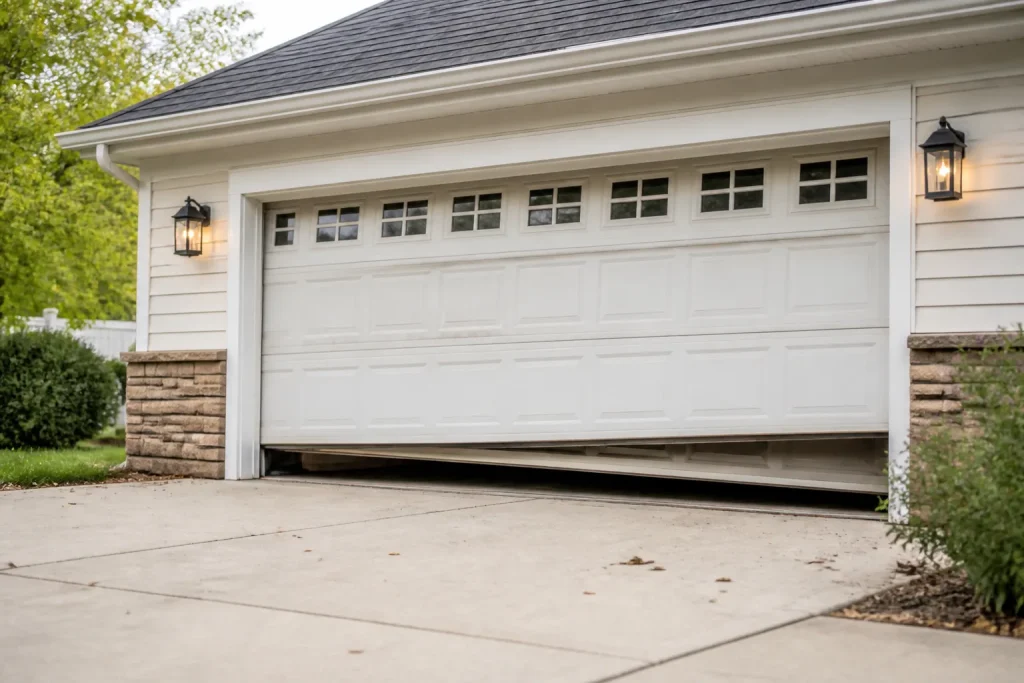
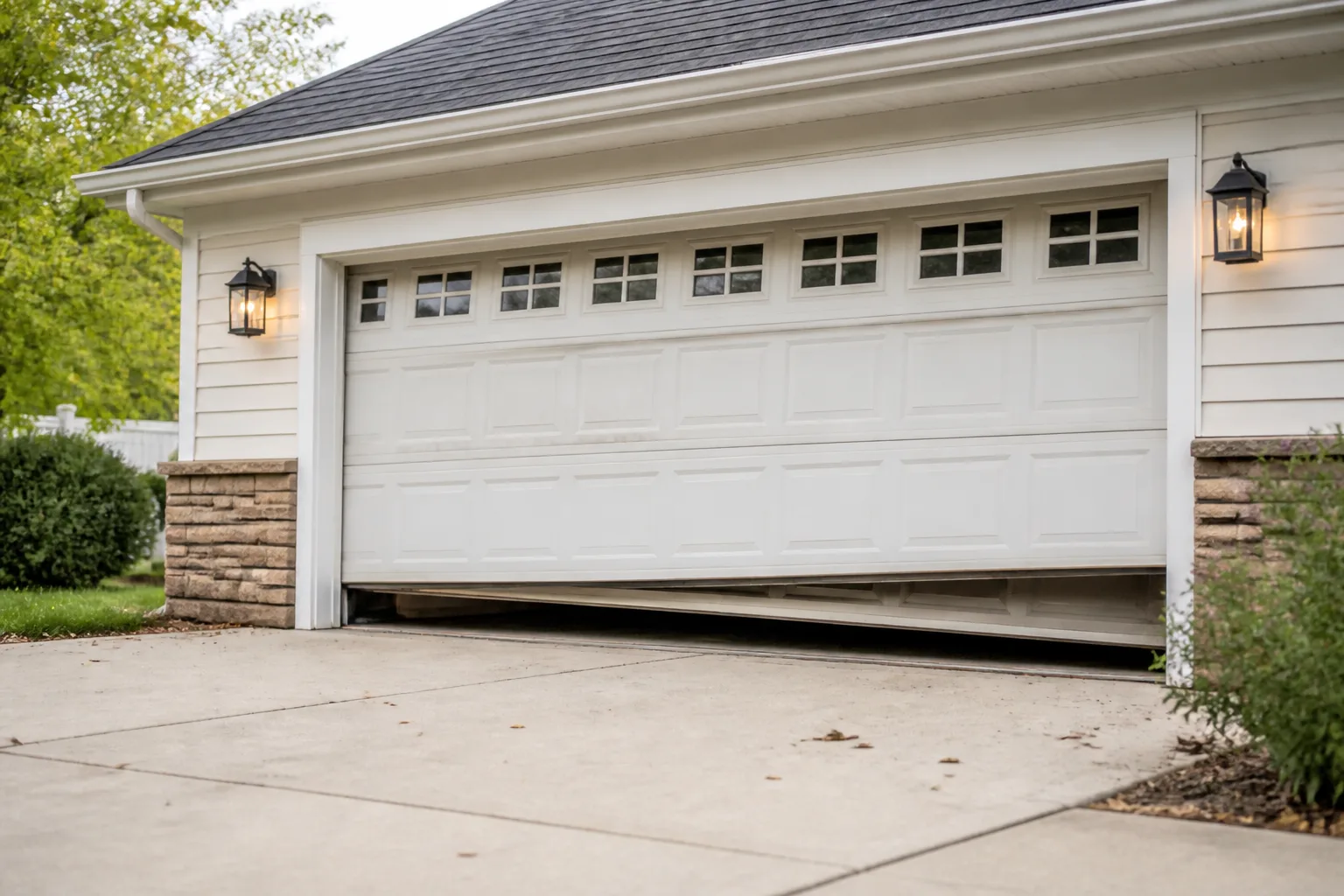
When one side of the door moves faster than the other, the door has a cable tension imbalance, and it typically shows up for a few days to a couple of weeks before a full cable failure. You can catch it by watching the door’s bottom edge as it opens: it should stay level with the floor. If one corner leads and the other trails, or the door visibly tilts, one cable is carrying more load than the other. Left alone, that imbalance stresses the weaker cable until it fails, and the door can drop on one side, which is a safety situation, not just an annoyance.
Cause-and-effect here is mechanical. A cable that’s too tight or too loose shifts the weight to the other side, so a single loose cable can take a healthy system down. Uneven travel also wears the tracks and rollers unevenly, which is why you can sometimes hear one side of the door grinding while the other is quiet. If the door tilts and won’t close flush, treat it as a call-it-in problem. A technician can re-tension the cables and level the door, which is a far smaller job than replacing the spring and track damage a dropped door causes.
Grinding vs. Squeaking vs. Rattling: What Each Sound Means
Sound is the cheapest diagnostic tool you have. Each of the three common noise profiles traces to different hardware, so listening before you call helps a technician know what to expect. Here’s how we sort them:
- Grinding usually traces to the opener’s internal gears or to a door roller that’s stopped turning and is dragging along the track. It’s a rougher, lower sound than the others, and it tends to get louder as travel continues.
- Squeaking is nearly always a dry hinge, roller bearing or torsion tube. Lubrication and a quick inspection typically solve it, and catching it early prevents the part from seizing.
- Rattling points to loose fasteners, a track bracket that’s come loose, or a door panel that’s vibrating in the guides. It’s often the easiest to fix, and the easiest to ignore until a loose bracket turns into a bent track.
One more: a single loud pop from the spring area is not a spring you should touch. Torsion springs are under extreme tension, and DIY handling is how serious injuries happen. That’s a trained-technician job, full stop. If you hear a pop and the door won’t lift, stop using the opener and call. We handle spring and hardware work across the brands we service, so there’s no guesswork.
Colorado Altitude and Temperature Swings: Why October and April
Southlands sits at altitude, and altitude combined with big temperature swings is hard on garage door hardware. Metal contracts in the cold and expands in the heat, and springs, cables and tracks all feel that movement, which is why the two seasonal checkpoints worth keeping are October and April. In October, you’re bracing for the first deep freezes: springs under-tension, cables tighten, and the balance test often tells you to address something before winter. In April, you’re in the thaw-and-refreeze stretch, and the hardware that survived winter can show new slack, loose brackets or a door that’s drifted out of level.
The specific reason to run a check at those two points is that a door doesn’t fail at a random moment; it fails when the moving parts lose the small clearances the system needs. Southlands homeowners who get a balance test and a quick visual in early spring and early fall catch worn springs and loose cables before they become a surprise. You don’t need a tool kit for this. You need a walk around the door and the ten minutes the balance test takes.
When to Call a Pro
Some of these signals you can handle with lubrication and a little time. Call a professional if the door sinks during the balance test, if the door tilts or won’t close flush, if you see loose or unwinding cable strands, if the opener strains or stops mid-travel, or if you hear a pop and the door stops moving. Springs and cables are the two parts of a garage door that cause serious injury when handled by untrained hands. Those are jobs for a trained technician, not a weekend project. If you’re unsure, a quick look is cheaper than waiting for the door to fail.
Related services in Southlands: if the door has stopped moving entirely, see garage door repair. If you’re replacing a failing system, garage door installation covers what to expect. For the front of the site, start at Garage Door Repair Southlands.
The Bottom Line
The signs worth acting on are the quiet ones: a slower door, a door that sinks in the balance test, one side leading the other, a cable that’s started to unwind, and a noise that’s changed in character. Those five cover the 60 to 90 day window where an adjustment or small part usually prevents a much bigger repair. In our experience, the Southlands homeowners who check their door in October and April are the ones who skip the emergency call. If you are in Southlands and need help, Garage Door Repair Southlands offers free estimates, so call (844) 569-7232. Our technicians have up to 8 years of experience, and we work on the major brands, so whatever is on your door, chances are we’ve seen it before.
Call (844) 569-7232. We answer 24/7. Fast dispatch from 7am to 7pm, Sunday through Friday. We’re closed Saturday, so a call on a Saturday books into the next opening on Sunday.
Frequently Asked Questions
The clearest early sign is a door that sinks during the balance test instead of holding its position at waist, shoulder and chest height. A slowing door or a strained-sounding opener often follows. If you hear a loud pop and the door won’t lift, stop using the door and call (844) 569-7232, because a failed spring is not a DIY repair.
Some are safe to handle: lubrication, tightening a loose bracket, replacing a roller. Anything involving springs or cables is not a DIY job, because those parts are under extreme tension and can cause serious injury. When in doubt, call (844) 569-7232 and we’ll tell you whether it needs a technician.
A slow door usually means the torsion spring has lost tension and the opener is carrying the full weight. An uneven door means a cable tension imbalance on one side, and that can lead to a cable failure in days rather than months. Both are worth a look before the door stops working. Call (844) 569-7232 for a free estimate.
Run a balance test and a visual check of the cables, tracks and brackets in October before the hard freezes and again in April during the thaw. That two-a-year routine is the practical schedule for a Colorado altitude climate. If anything looks off between checks, call (844) 569-7232. We answer 24/7, with fast dispatch from 7am to 7pm, Sunday through Friday.
Written by the team at Garage Door Repair Southlands.
Need Garage Door Help?
Call Garage Door Repair Southlands - the local pro we connect you with is licensed and insured, here with fast help in Southlands.
(844) 569-7232